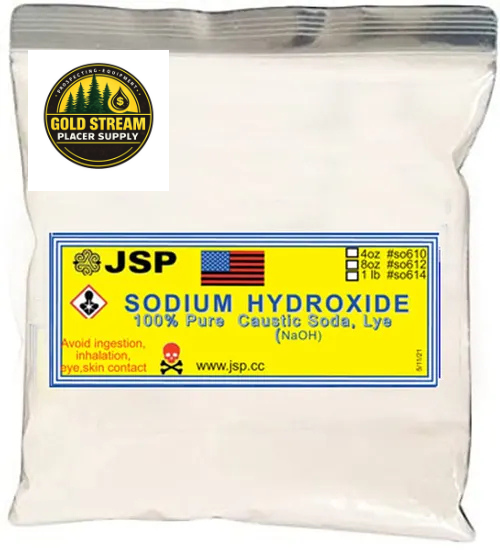
Sodium Hydroxide (caustic soda)/lye.
PN: SO612
Sodium hydroxide (NaOH), also known as caustic soda, plays several important roles in gold refining, primarily as a pH adjuster, neutralizer, and precipitating agent.
-
Precipitation of Gold: When added to a solution containing gold(III) chloride (auric chloride, AuCl₃), sodium hydroxide first forms a brown precipitate of hydrated gold(III) oxide (Au(OH)₃). In excess NaOH, this precipitate dissolves to form soluble sodium aurate ions ([Au(OH)₄]⁻ or [AuO₂]⁻). Upon gentle heating, the aurate decomposes to gold metal. This method can produce high-purity gold, as noted in user experiments where the resulting gold powder melted into a shiny, tarnish-free button.
-
Neutralization and pH Control: NaOH is used to neutralize acidic solutions (e.g., from aqua regia or nitric acid) during refining. Maintaining a high pH (above 10.5) is critical in processes like gold cyanidation, where it prevents the formation of toxic hydrogen cyanide (HCN). In industrial settings, lime (Ca(OH)₂) or NaOH is added to keep the solution alkaline.
-
Pretreatment of Refractory Ores: In advanced processes, NaOH pretreatment helps break down complex mineral matrices (e.g., antimonial ores) to improve gold recovery by liberating gold from locked-in structures.
-
Caution and Limitations: While effective, NaOH can damage gold plating if used on gold-coated objects, especially under high concentration, heat, or prolonged exposure. It is not selective and may precipitate other metals, unlike more targeted agents like sodium metabisulfite (SMB). Therefore, it’s best used in clean, well-controlled solutions.
-
Safety: Handling NaOH requires strict safety measures—use of gloves, eye protection, and ventilation due to its corrosive nature.
In summary, sodium hydroxide is a versatile chemical in gold refining, useful for precipitation, pH control, and ore pretreatment, but must be applied carefully to avoid unwanted side reactions or material damage.